
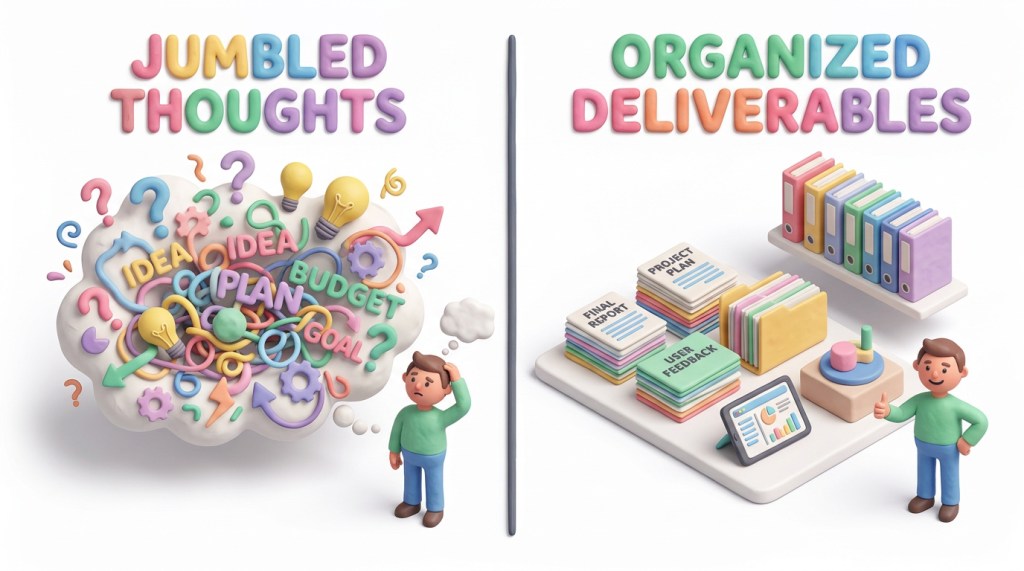
Three weeks ago, I started using Claude (Sonnet, specifically) as a genuine working partner for my marketing department. It started with one project. Then another. And another.
And then, because I suddenly had time to think for a minute, for darn near everything I could think of backlogged or otherwise made sense.
After that, I recently sat down to estimate what that actually produced because who doesn’t want to track such things. I knew it was a lot, but the number of hours – never mind the dollars saved! – was way larger than I expected.
What Three Weeks Actually Produced
Across roughly 20 working sessions, here’s only part of what came out of a two-person association marketing department operating with AI as a consistent collaborator:
- A fully refreshed brand guide, including 12 sections, five complete drafts, gap analysis, appendices, boilerplate copy, AI usage policy, and crisis communications protocol.
- A 36-article content series for six departments, totaling roughly 12,600 words of purpose-built, strategically aligned content.
- Six department infographics built on a full design system, iterated through multiple rounds.
- A full-site content audit that spanned 99 pages and provided detailed findings from a custom, purpose-built crawler.
- A fiscal year business plan
- A competitive intelligence report
- Conference landing page copy
- Presentation templates
- Meeting summaries and documentation
- An annual campaign playbook
- A role-by-role AI disruption assessment
The honest estimate of equivalent professional hours: 260 to 325. At a conservative blended rate for the mix of strategy, writing, and design work involved, that’s somewhere between $20,000 and $32,000 in professional services — compressed into three weeks of asynchronous conversation.
And all done in step with a whole lot of regular duties in my 40-hour’ish week.
What the Hours Number Means … and Doesn’t Mean
The number deserves context, because it’s easy to misread it in both directions.
Flatly, it doesn’t mean AI did 260 hours of work while I watched. Every significant output in that list required real professional input: strategic direction, source material, editorial judgment, factual correction, and often multiple rounds of pushback.
The brand guide went through five drafts because four of them weren’t right. The competitive intelligence report is useful (but not an authoritative resource) because we knew the competitive landscape well enough to catch errors and fill the gaps. The business plan made the argument it made because I understood the organizational dynamics it needed to navigate.
What AI replaced was the production time — the hours spent drafting, formatting, restructuring, and iterating that would have consumed most of those 260 hours if done manually. The thinking time remained mine. The judgment remained mine. The institutional knowledge that made any of it specifically accurate and organizationally useful remained mine.
The More Important Point
Most of this work wouldn’t have happened at all in a two-person department without AI. Not because I lacked the skill to do it. Because I lacked the time. The brand guide has been on the strategic priority list for two years. The competitive intelligence report happened quarterly in my head and never on paper. The department infographics existed as a concept that never made it past the concept stage.
That’s the more honest accounting of AI’s value in a lean association: not just time saved, but work that actually gets done instead of staying permanently on the someday list. Infrastructure that gets built instead of deferred. Strategic work that gets done by the person who should be doing it, rather than not getting done because that person is too busy producing deliverables to think.
What This Changes About the Role
The usual argument for AI in marketing is efficiency: the same output, faster. That’s true as far as it goes. The more significant shift is strategic: a Director of Marketing who can produce at this rate isn’t just more efficient. They’re operating at a different level of the job with much more time to breathe in strategic-level air.
The brand guide isn’t just a time-saving win. It’s a governance document that didn’t exist and now does. The competitive intelligence report isn’t a productivity metric. It’s organizational knowledge that now informs decisions it didn’t before. The business plan isn’t proof that AI can draft proposals faster. It’s a real strategic document that makes a real argument to real leadership — and it exists because AI made the production of it possible in the time available.
The difference between a marketing function that operates reactively and one that operates strategically is almost never about skill. It’s almost always about capacity. For a lean association marketing department, AI doesn’t just save time. It creates the capacity for the kind of work that actually moves the organization.
The Honest Caveat
What I’ve done over the past several weeks doesn’t automatically mean you would get the same outputs. This AI stuff doesn’t scale uniformly because the quality of what AI produces is directly proportional to the quality of what you bring to it: the specificity of your brief, the accuracy of your source material, the rigor of your editorial review, and the depth of your organizational knowledge.
A communicator without that foundation will get generic output at higher speed. A communicator with it will get a force multiplier.
The 260 hours is what it would have taken someone else to produce this work without the context I carry into every session. That context is the professional asset. AI is the production infrastructure that makes it expressible at scale.
Three weeks. Twenty sessions. One two-person department. The incredible amount of output exists now — in shorter time but still on point and at high quality — giving me time to breathe and think forward.
And, that’s the point.


 Kitchen's Ink
Leave a comment