

Most AI adoption in marketing departments follows the same arc:
Someone discovers the tool, starts using it enthusiastically, produces content that’s faster but somehow flatter, and then either abandons the tool or settles into using it for low-stakes tasks while doing everything that matters manually.
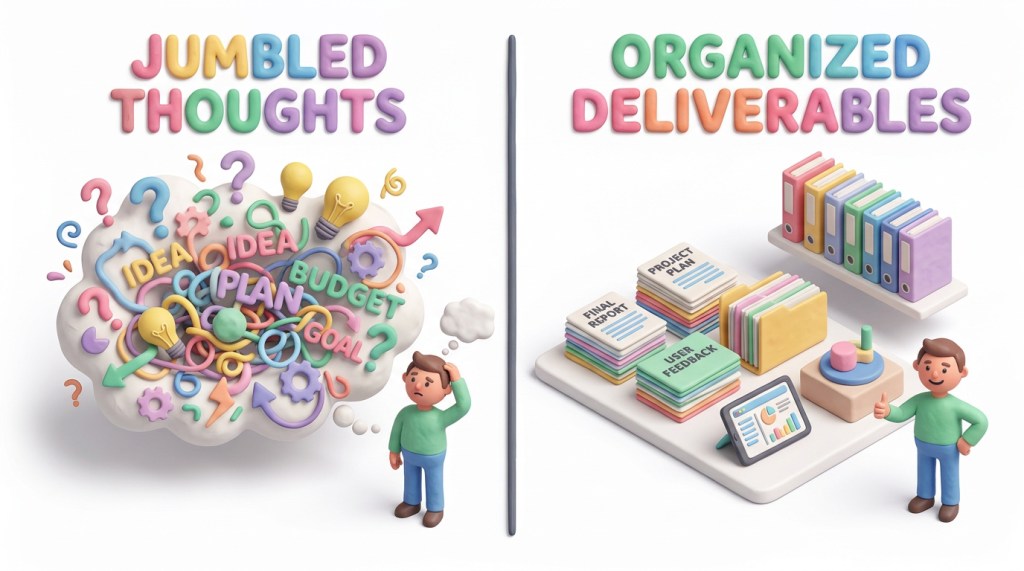
The problem is rarely the tool. It’s the absence of a workflow.
With a workflow, AI becomes a reliable production partner rather than an unpredictable experiment.
What a Workflow Is and Isn’t
A workflow is a repeatable process with defined inputs, defined steps, and a defined output. It’s not “use AI when you need it.” It’s a specific sequence: here’s what I bring to the tool, here’s how I interact with it, here’s what I do with what comes out.
Without that structure, AI use becomes situational and inconsistent. The output quality varies. The time savings are real on some tasks and nonexistent on others. The voice drifts because different prompts produce different registers and nobody’s enforcing consistency.
With a workflow, AI becomes a reliable production partner rather than an unpredictable experiment.
The Four-Stage Workflow That Works
For content production specifically, the workflow that produces consistent quality has four stages.
Stage one is the brief. Before the AI sees anything, you’ve answered: who is this for, what do they need to believe, what’s in the way, and what specific source material or organizational context does this need to reflect. The source material is critical — the more real, specific information you push in at this stage, the less the output sounds like everyone else’s AI content.
Stage two is the draft. You give AI the brief and the source material and ask for a draft. Not a perfect draft — a working draft. The prompt should include voice guidance: here’s an example of content in our voice, here are words we don’t use, here’s the register we’re aiming for.
Stage three is the editorial fight. This is the human stage and it’s non-negotiable. You read the draft looking for three things: what’s factually wrong, what’s tonally off, and what’s missing that only you would know to add. The editorial fight is where your voice goes back in. If you skip it, the output is AI’s voice wearing your colors.
Stage four is the review against the brief. Before anything goes out, you check it against the original brief. Does it serve the specific audience you identified? Does it address the hesitation you named? Does it lead with the right thing? This takes two minutes and catches most of the errors that make AI-assisted content fall flat.
Where Voice Gets Lost and How to Keep It
Voice gets lost in two places. The first is the prompt — when there’s no voice guidance, the AI defaults to a generic professional register that’s technically correct and distinctively nobody’s. Fixing this is straightforward: include one or two examples of your actual content in the prompt and tell the tool to match the register, not just the topic.
The second is the editorial stage — when the draft is good enough and the deadline is close and the temptation is to publish without the fight. This is where volume becomes the enemy of voice. When you’re producing at AI speed, the editorial stage gets compressed. That compression is where homogenization happens.
The workflow protects against both. The voice guidance in the prompt reduces the drift in the draft. The mandatory editorial stage catches what gets through anyway.
A Realistic Time Expectation
A well-run AI workflow for a 600-word content piece takes about 30 to 45 minutes: 10 minutes to write the brief and gather source material, 5 minutes to prompt and get the draft, 15 to 20 minutes for the editorial fight, 5 minutes for the brief review.
The same piece done manually takes two to three hours. The savings are real. But they come from the production stage, not from eliminating the strategic and editorial stages. Those stay. That’s the workflow.


 Kitchen's Ink
Leave a comment