
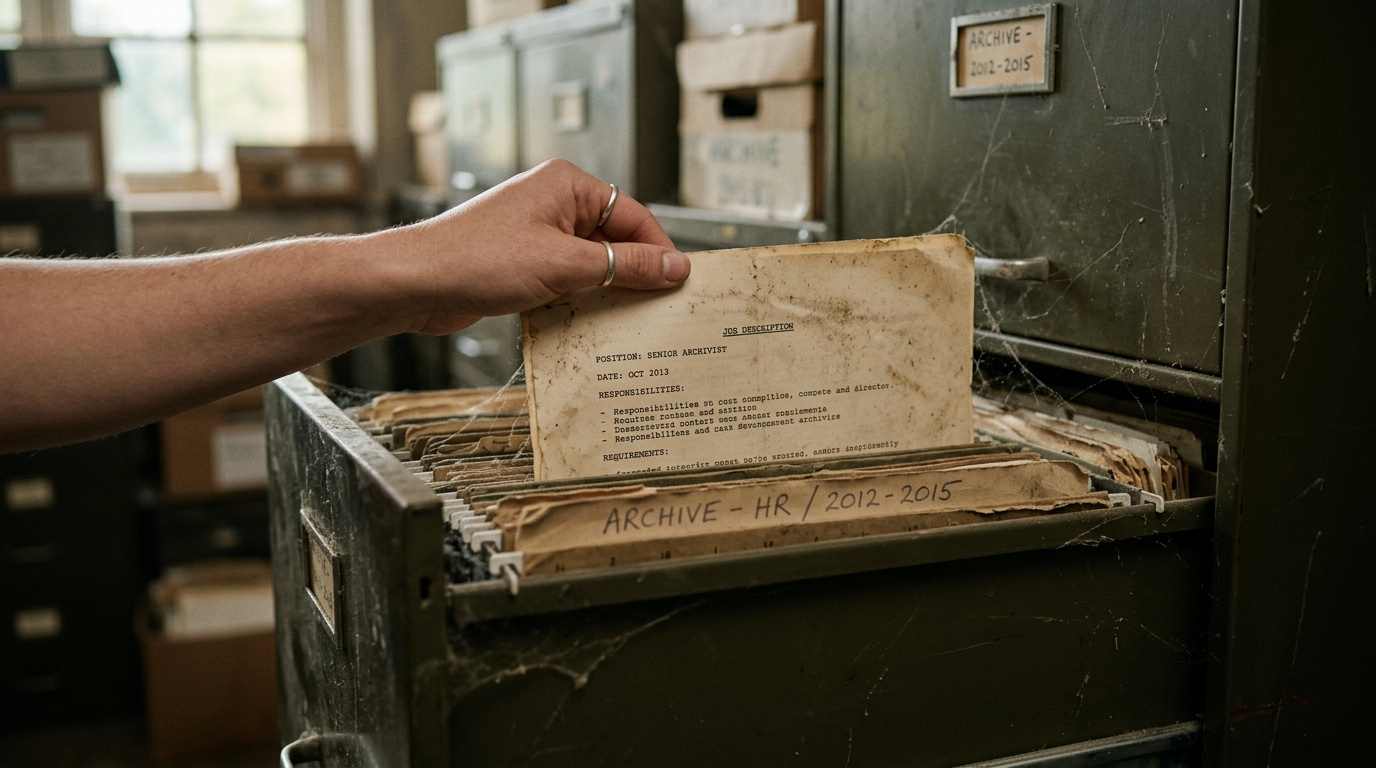
Every association has at least one job description that should have been retired years ago.
You know the one. The title hasn’t changed, the salary band hasn’t changed, and nobody has looked at the actual description document since the last time someone left the role. It’s sitting in a shared drive somewhere, waiting to be dusted off the next time a position opens up.
The problem isn’t that the document is old. The problem is that the job changed and the document didn’t, and nobody noticed because institutional knowledge lives in people — not in files.
Many times job descriptions get written when a position is created or when someone leaves. In between, the role evolves — the tools change, the responsibilities shift, the priorities of the organization move.
The Dusty Job Description Problem
I’ve been on the hiring side of this.
Once, I pulled a job description that was eight or ten years old. The title hadn’t changed. The posting looked fine. And then I started getting applicants — or rather, not getting them — and I couldn’t figure out why the role wasn’t generating much or the right kind of interest. When I dug into it, the answer was obvious in hindsight: I was advertising for something that didn’t match what the market understood that title to mean anymore.
The document wasn’t wrong in terms of what the role used to be, but the job had evolved significantly over a decade. And now, it was completely disconnected from what the association needed. It asked for a combination of skills and responsibilities that, in living color, were outdated skills and/or updated skills split among different or multiple roles.
A reimagining and refresh cleaned that up.
This next scenario — starting from scratch — is harder. No documentation, no prior description, nothing to react to. Sounds like flexibility and freedom, right?
It isn’t.
I needed to build a job description from the ground up for a coordinator-level role that required expertise I didn’t personally have. This put me in a spot, I quickly found out, where I was essentially designing and building a position that included skills I couldn’t fully evaluate.
I knew what outcomes the role needed to produce. I didn’t have the same career path or technical background to know exactly what the day-to-day work looked like for someone doing it well. That gap showed up in the hiring process, in the onboarding, and eventually in how long it took the person we hired to become fully effective.
What did that take?
Eventually, I developed my own skills and knowledge related to the role to a solid level and became effective at managing it (there’s something to be said for that because a lot of directors, managers, etc. don’t for one reason or another), but the flight to that destination was sometimes bumpy and uncomfortable.
It was a learning process, no doubt, and one that instilled in me the importance of keeping your staff roles current — and documented.
What This Is Actually About
Both of those scenarios have the same root cause: the organization didn’t build the infrastructure to capture what roles actually became over time.
Many times job descriptions get written when a position is created or when someone leaves. In between, the role evolves — the tools change, the responsibilities shift, the priorities of the organization move — and none of that gets documented as it relates to the role. It lives in the institutional memory of the person doing the job and the people who work alongside them. When that person leaves, the memory goes with them.
This is the documentation problem that associations almost never talk about, because it doesn’t feel urgent until you’re in the middle of that next hiring process and the whole thing feels askew.
All Roles Should Have A Plan
The conversation about institutional knowledge and succession planning usually focuses on executive leadership. What happens when the ED leaves. How does the organization preserve the relationships, the strategic context, the board history?
Those are important items, of course. But, they definitely aren’t the only ones, and it’s not even where the damage shows up most consistently. It shows up at every level — the coordinator who was the only person who knew how the database was actually structured, the communications manager who kept the editorial calendar in their head, the events staff member who had 15 years of vendor “let’s just keep doing what we’ve been doing” two-minute-phone-call relationships that were never written down anywhere.
Every one of those departures is a small version of the same crisis. And in small-staff associations, there’s no redundancy to absorb it. When one person walks out the door with institutional knowledge, the organization doesn’t just lose an employee. It loses the custom-built cog in the association’s suddenly-not-smooth-running machine.
Treat Job Descriptions As Living Documents
The fix isn’t complicated, but it requires treating documentation as ongoing work rather than a one-time task.
Job descriptions should be living documents — reviewed annually, updated when the role shifts, and written to reflect what the position actually does today, not what it did when it was created. That review doesn’t have to be elaborate. It can be a thirty-minute conversation between a staff member and their supervisor once a year: what has this role become, and does the description still reflect it?
Process documentation should be a standard part of every role, not something that gets created in a panic during offboarding. The person who knows how something works should be writing it down while they’re doing it — not after they’ve decided to leave.
And when a position does open up, the first question shouldn’t be: “Where’s the old job description?” The conversation should center on what the position has become and what the organization actually needs it to do next.
The associations that get this right don’t start from scratch every time someone leaves. They’re building on a documented foundation that reflects the organization as it actually exists — not as it did eight or ten years ago when someone last wrote it down.



Leave a Reply