
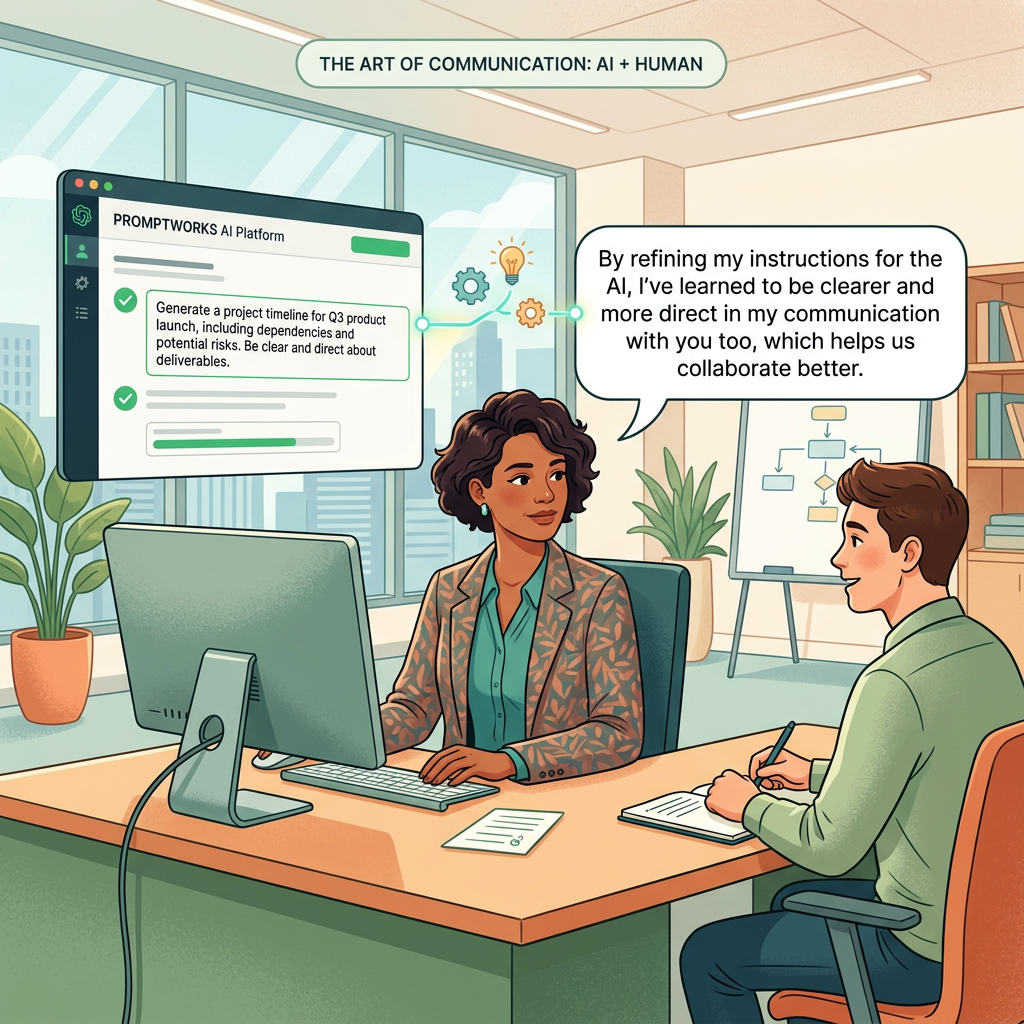
I didn’t see this coming. Working with AI has made me a better manager.
I’m a clearer communicator. I’m more direct (but always with respect and kindness) with people. I’m more specific – with more information – up front. I’m better at setting up the work so the person doing it doesn’t have to guess.
Maybe those are things you already were good at. That’s awesome. But, it was a benefit to working with AI I didn’t have on my personal Bingo card.
The Problem I Didn’t Fully See
Before all of this, I had habits I didn’t fully recognize as actual habits.
I’d couch things — softening a direction that was just going to be hard work, trying to make it more palatable. Or, I’d dance around a point instead of making it. Or, I’d start a project with just enough direction to get going and then wonder why the result wasn’t what I had in my head, because I hadn’t explained what was in my head clearly enough at the beginning.
The irony isn’t lost on me. A tool built to respond to human language ended up teaching me something about how to use human language better.
Our web audit process is a clear, recent example. I knew we needed one. I knew it mattered. What I didn’t have was a clear picture of what it looked like in scope, where to start, how to proceed, how to document, etc. So, when I tried to explain what I wanted to an employee, the explanation was as fuzzy as my own thinking. Predictably, the work stalled.
None of that, unfortunately and unfairly, stopped me from getting impatient or agitated that it wasn’t getting done. I admit that full-throat.
What changed that wasn’t a management workshop or a book on communication. It was going through the audit development process with Claude. In order to get Claude to do useful work, I had to get clear on what I actually wanted. What the scope was. What the output should look like. What success meant.
It took awhile. A lot of fumbling ideas, half-thoughts, seeing what Claude would develop or say in feedback and adjusting. It all led to the output I wanted eventually. But, it was the sharpening of my own thinking process – including realizing what led to the desired output and how I sounded when I typed it or said it into the microphone – that I eventually picked up on.
And once I had done that thinking — once I could explain it well enough, early enough, for a model to execute — I could explain it well enough for a person to execute too. And, beautifully, the employee who had been circling it finally had something concrete to work through. And they worked through it incredibly well.
What Prompting Actually Teaches
Prompting well requires clarity, specificity, and a concrete picture of the desired outcome.
When a prompt is vague, the output is vague. When it dances around the point, the model fills in the gaps in whatever direction makes sense to it — which is often not the direction you needed. When you leave the scope open, you get scope. When you explain what you want in detail upfront, you get something you can actually use.
Every one of those dynamics maps directly to working with people..
The difference is that with people, the misalignment takes longer to surface and costs more when it does. A fuzzy prompt to Claude produces a fuzzy first draft I can redirect in thirty seconds. A fuzzy direction to a person produces a third draft — or no draft at all — and a conversation that should have happened at the beginning.
I learned to give AI everything it needed upfront. Then I started doing the same with people. Shorter communications. More direct. Specific on goals, specific on output, specific on what I need and what I don’t. Still respectful, still calm — just not dancing.
The Shift in How I Work With People Now
The pattern now looks like this: I see a vision, I provide the goals, I give as much specific direction as I can about what I need in the output, and then I let the other person’s creativity get us there. I don’t over-specify the how. I specify the what and the why, and I let someone else figure out the path.
That’s actually how good prompting works too. You don’t tell the model every step. You tell it what you’re trying to accomplish, what the output should contain, what constraints matter — and then you let it work. Micromanaging the process produces worse results than trusting the execution once the direction is clear.
I don’t know if the people I work with have noticed the shift. They might not know why things feel different. But they can see what the outputs look like. We’re producing more than we ever have, in shorter timeframes, with better quality — staying on brand, aligning to board strategic direction, moving from idea to execution without the usual number of rounds to get there.
The shorter timeframe isn’t from working faster. It’s from building the brief better. The clarity that used to show up in a third draft now shows up in the first conversation.
The Part I Didn’t Expect
I expected AI to make me more productive. I didn’t expect it to make me more precise as a communicator with the people around me.
The irony isn’t lost on me. A tool built to respond to human language ended up teaching me something about how to use human language better. Not more elaborately. Not more persuasively. More clearly. More specifically. More usefully.
If you’re using AI seriously in your work and you haven’t noticed this effect yet, it might be because you haven’t had to get specific enough yet. The real shift happens when you stop accepting a mediocre output and start asking yourself why the prompt produced it — and what you’d have to say differently to get what you actually needed.
The answer to that question, nine times out of ten, is the same answer that would have helped the person you were managing.



Leave a Reply